Learn car theory in Belgium: the best way in 2026
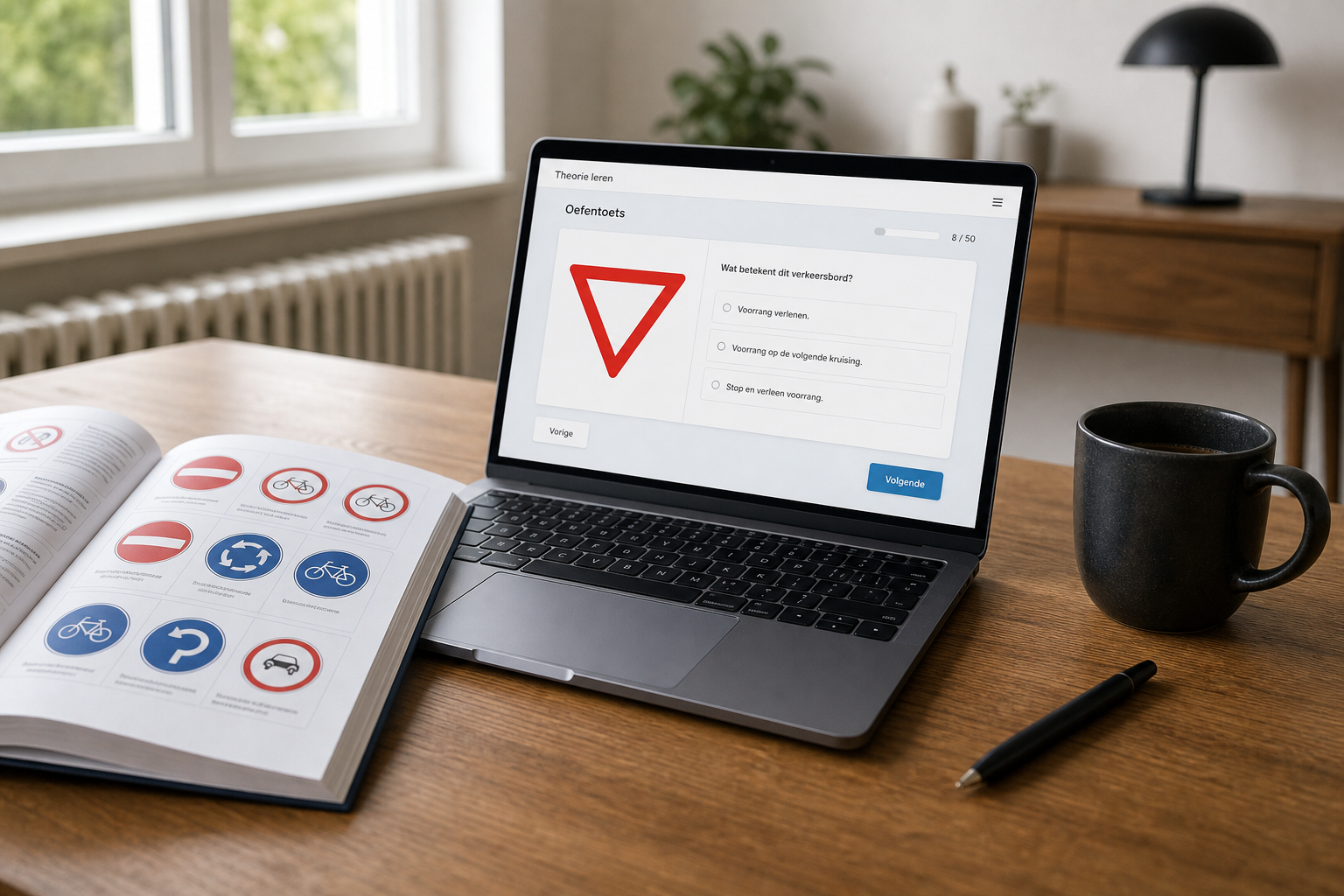
Learning car theory in Belgium feels like a mountain for many candidates: thick books, endless signs, and an exam that looks stricter than you expected. Most preparation still fails because of the method, not a lack of effort. If you only read, you remember too little. If you only practise without understanding, you guess. This guide sets up a plan that actually works — practical, Belgian, and aimed at the real GOCA theory exam (licence B).
No promises that you will “pass in three days”. You do get a clear approach: why your study method matters, how to build a weekly plan, how to use mock exams, and which mistakes to skip. Ready to start? You can practise a free theory exam while you read this.
Why your learning method matters (more than “one more late-night cram”)
The Belgian theory exam does not test whether you can recite a handbook. It tests whether you make the right choice in a few seconds: right of way, sign, speed, hazard. That is why “I’ll just read everything again” works badly. Your brain keeps what you use.
A strong way to learn car theory rests on three pillars:
- Understand — what does the rule mean, and when does it apply?
- Apply — practice questions and situations, not text alone.
- Correct — talk through every mistake until you know the reason.
Repeat that loop and the same themes stop tripping you. Do “another set of questions” with no analysis and you keep making the same errors — you will feel that on exam day.
Want to know how high the bar is? Read how strict the exam is in car theory exam: how many mistakes can you have?. That helps you practise realistically instead of “roughly enough”. We do not copy scoring claims here; that post is the place for them.
Official rules live in the Belgian highway code (the wegcode), with exam organisation via GOCA Flanders — category B and FPS Mobility. Always check those sources; we do not invent fees or pass marks.
The best way: a simple study plan for Belgium
“Best way to learn car theory” sounds like a marketing line. In practice it is regularity + feedback. Below is a plan you can fit around your diary — student, job, or retake.
Step 1 — Split the material into themes
Do not work “from page 1 to 200”. Group:
- traffic signs and road markings
- right of way and junctions
- speed, distance and overtaking
- vulnerable road users (cyclists, pedestrians, tram, …)
- hazard perception and risk situations
- admin / practical exam-day rules (what you may and must do)
Per theme: a short read or video → 15–25 practice questions → note the mistakes → repeat those rules.
Step 2 — Short sessions, more often
Prefer 5 × 40 minutes a week over one four-hour marathon. After an hour, focus drops; then you mainly “learn” that you are tired. End each session with three sentences: what went wrong, why, what do I do differently tomorrow?
Step 3 — Build up to exam format
First week(s): themed practice.
Then: mixed sets.
Last phase: full mock exams on the clock, phone out of reach.
A useful checklist of exam tactics is in our 11 tips to pass the theory exam and the shorter theory exam tips.
Sample week (adapt to your pace)
| Day | Focus | What you do |
|---|---|---|
| Mon | Signs | Short explanation + 20 questions |
| Tue | Right of way | Situations + error list |
| Wed | Speed & distance | Rules + mixed set |
| Thu | Weak themes | Only what went wrong yesterday |
| Fri | Mini-exam | 25–50 questions on the clock |
| Sat | Review | Rewrite the rules in your own words |
| Sun | Rest or light recap | Do not force new material |
This is not a driving-school timetable — it is a rhythm. The point of learning car theory in Belgium: every week fewer “I had no idea” moments and more “I recognise this”.
Mock exams: how you actually get something out of them
Practice is not an endless quiz marathon. It is diagnosis. After every set, ask yourself:
- Was this a knowledge gap or a reading error?
- Would this be a minor or a serious mistake on the real exam?
- Can I explain the right choice in one sentence to someone else?
If you cannot, you do not know the rule yet — you only recognised yesterday’s answer.
In practice:
- Start with free theory exam practice to see your starting level.
- Note themes with repeated mistakes (right of way, signs, …).
- Study only those themes again.
- Do another mixed set or a full mock exam.
- Repeat until your score is stable — not until you “got lucky”.
More on exam-focused practice: practice car theory exam. If you want more volume and explanations without organising everything yourself, look at the packages to order. You can also keep drilling on practice car theory.
Common mistakes when you learn car theory
You can study for hours and still get stuck. We see this often:
1. Only reading, rarely applying
A handbook or summary feels productive. On the exam you must choose under time pressure. Without practice questions, knowledge stays “passive”.
2. Clicking past mistakes without an explanation
“Ah, wrong — next.” Then you learn nothing. Write down the reason. One sentence is enough.
3. Starting full exams too late
If you try a whole exam only the night before, you discover panic at the worst moment. Build exam format in early.
4. Mixing Dutch CBR material with Belgium
Useful if you live in the Netherlands — confusing if you sit the exam at GOCA or a Belgian exam centre. Sign codes, right-of-way nuances and exam format differ. Pick material that is explicitly for Belgium, not CBR.
5. Trying to tick everything at once
Three apps, two books, YouTube and panic flashcards. Choose one core method and stick with it until your weak themes are under control.
A wider list of exam mistakes (not only study mistakes) is in 13 mistakes to avoid on the theory exam.
How do you know you are ready?
There is no magic score that fits everyone, but these are healthy signals:
- You pass several full mock exams in a row at a level you trust.
- You can explain why an answer is correct — especially for right of way and hazards.
- You read questions more calmly: fewer “I filled something in too fast”.
- Your week-1 weak themes are no longer your top errors.
Still unsure? Do not book an exam “just to get it over with”. Plan two or three focused practice days. That is cheaper (in time and nerves) than a retake you could have avoided.
For the legal background, see Vlaanderen — driving licence and FPS Mobility. Check GOCA or your exam centre for the latest booking rules; we do not invent fees.
In short
Learning car theory in Belgium works best as a simple loop: understand → practise → review mistakes → repeat. Short sessions beat weekend marathons. Mock exams are not a goal in themselves — they are a mirror. And Belgian material stops you from studying the wrong rules by accident.
Ready to put that method into practice? Start today with free theory exam practice. If you want a more complete preparation with more structure, see the options to order. Good luck — you do not need a “perfect” study method, just one that makes you a bit more sure of yourself every week before your theory exam. Browse more guides on the blog.
Frequently asked questions
What is the best way to learn car theory in Belgium?
Combine short study sessions with lots of practice questions. Learn the core rules first (right of way, signs, speed), then practise by theme, and finish with full mock exams. You remember more that way than by reading a book cover to cover.
How long does it take to learn car theory?
It depends on the person. With a solid plan of 30 to 60 minutes a day, many candidates are ready in a few weeks — if they actually practise and review their mistakes. Cramming in a single weekend is usually a poor strategy.
Should I learn everything first or start mock exams immediately?
Start with the basics, then switch to practice questions quickly. That shows your gaps at once. Full mock exams are most useful once you already know some of the material and want to train timing and exam pressure.
Where can I practise the theory exam in Belgium for free?
On Theoriedoen.be you can practise a free theory exam with questions in the style of the Belgian GOCA exam. Use those sessions to find weak themes, then study those topics on purpose.
What is the difference between studying and only practising?
Practising without understanding the rule turns into guessing. Studying without practising feels safe until you see the clock on exam day. The best way is: understand the rule, apply it in questions, and repeat what went wrong.
How do I know I am ready for the theory exam?
If you pass several full mock exams in a row, you can explain why an answer is correct (not just “this one was right”), and heavy themes such as right of way and hazard perception are under control, you are in good shape. If you still doubt, plan extra practice days instead of booking immediately.