Mandatory Traffic Signs in Belgium: Meaning, Access and Exam Questions
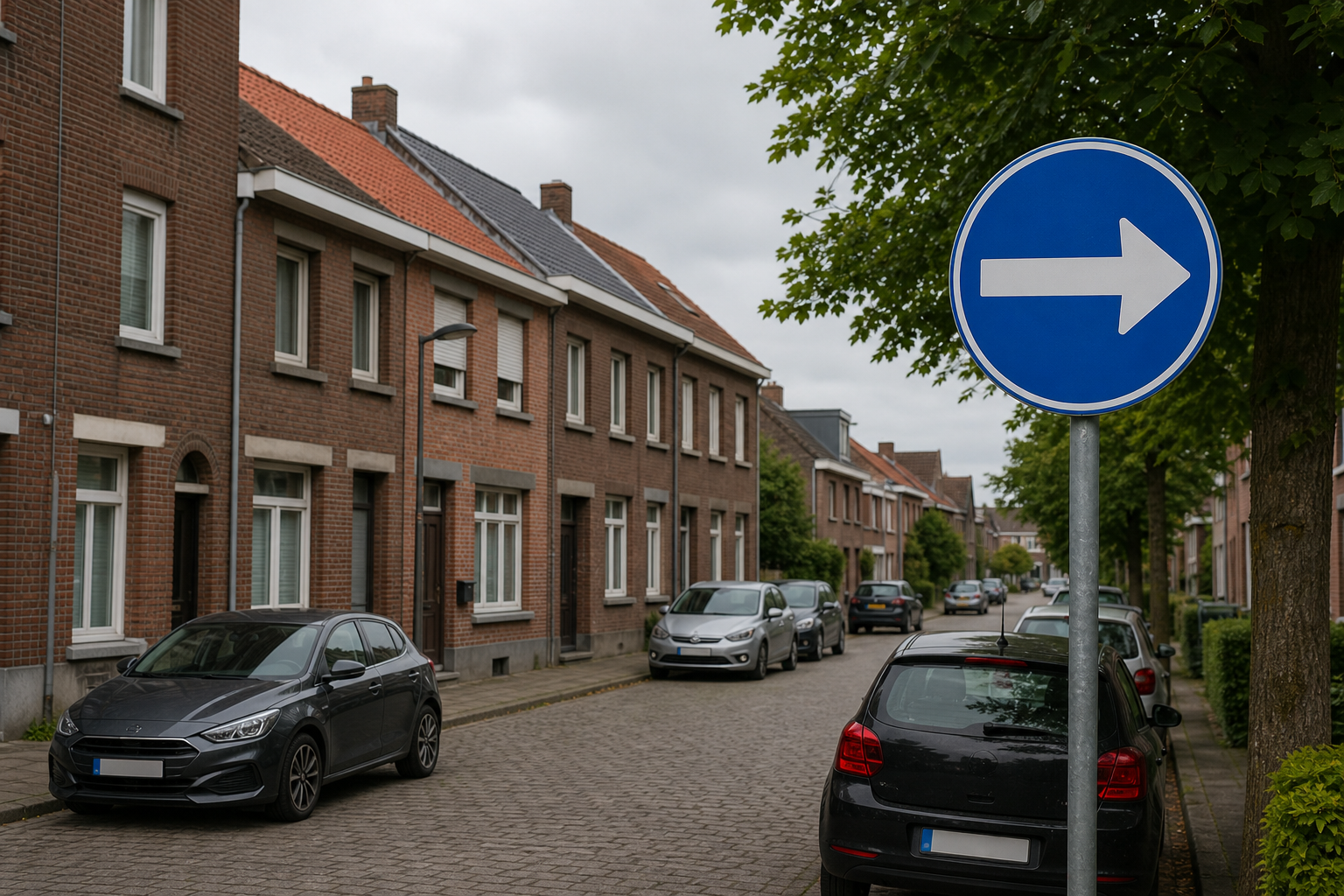
You spot them immediately: round, blue, white pictogram. Still, mandatory traffic signs are one of the topics Belgian theory-exam candidates keep tripping over. Not because the shape is hard, but because you have one second to decide what is compulsory, for whom, and whether a supplementary plate changes the rule.
This guide covers the meaning of mandatory traffic signs in Belgium, the difference with prohibition signs, what access signs (D7, D9, D10) do, and which direction signs (D1, D5) you can expect on the GOCA exam. The official rules sit in the Belgian highway code (Royal Decree of 1 December 1975, article 69). Always check that source or GOCA Flanders — category B for the latest exam information; we do not invent fees or pass scores.
What are mandatory traffic signs?
Mandatory traffic signs require a specific behaviour. In Belgium they form the D-series. You recognise them by:
- a round shape
- a blue background
- a white pictogram (arrow, bicycle, pedestrian, horse rider, …)
From the point where the sign stands, you must follow the obligation. It is not a tip, not a recommendation, and not “if it suits you”. On the theory exam that is the first split: must I do something, or must I not do something?
The highway code lists the mandatory signs in article 69. An overview of the D-series is also on Wikipedia — road signs in Belgium; always test that against the official text.
Mandatory, prohibition or danger: look at the shape first
Exam photos often show a sign and four meanings. Start with the shape, then the pictogram.
| Type | Shape | Colour | What it does |
|---|---|---|---|
| Mandatory sign (D) | Round | Blue, white pictogram | You must do something |
| Prohibition sign (C) | Round | White, red border | You must not do something |
| Danger sign (A) | Triangle | White, red border | You are warned |
That sounds simple until you see a blue sign with a bicycle and think: “handy, I may cycle there.” No. If it is a mandatory sign, the cyclist (and usually the moped class A) must use that part of the road. Cars do not belong there.
Want the classic C-series traps again? Read 5 prohibition signs you’re getting wrong more often than you think. For the triangles: top 8 danger signs to know.
Access mandatory signs: who may use which space?
Course material and exam questions often split mandatory signs into two blocks. The first block is access signs: signs that say which part of the public road is reserved for whom.
Those are mainly:
D7 — compulsory cycle path
Traffic sign D7 marks a cycle path. Under article 2.7 of the highway code, a cycle path is the part of the public road reserved for bicycles and two-wheeled mopeds class A (via D7, D9 or the markings of article 74). The cycle path is not part of the carriageway.
Practical for you as a car driver: you do not drive on it, you do not park on it, and when you cross a cycle path you give way to whoever may use it under the rules.
Practical for cyclists: if the cycle path is signed in your direction of travel, you follow it. If it lies on your left, you are not obliged to follow it when special circumstances justify that and you stay on the right in your direction of travel. That is in article 9.1.2.
D9 — pedestrians, bicycles and moped class A
D9 (in the official series also as D9a) reserves a part of the road for pedestrians, bicycles and two-wheeled mopeds class A. It is broader than “cyclists only”. Exam trap: “may a car enter here?” No. “May a moped class B use this just because of D9?” Not on D9 alone; look at the speed limit, the place and any supplementary plates.
D10 — pedestrians and cyclists
D10 reserves a part of the road for pedestrians and cyclists. Cyclists must use that part. Cars and motorcycles must not. In Wallonia, sections marked D9 or D10 also have a 30 km/h speed limit; check the current regional rules in the highway code (article 11.1, Walloon Region).
D11 and D13 — pedestrians and horse riders
- D11: compulsory path for pedestrians.
- D13: compulsory path for horse riders.
Note: these are the Belgian codes. Do not mix them up with Dutch CBR signs (minimum speed, compulsory direction with other numbers). You sit a GOCA exam, not CBR.
Moped class B and speed pedelec: read the supplementary plate
Many exam questions land here. The main rule from article 9.1.2:
- Where the speed limit is 50 km/h or less, drivers of two-wheeled mopeds class B and speed pedelecs may use cycle path D7, provided they do not endanger other users. Speed pedelecs may also use D9 in the same circumstances.
- Where a higher speed limit applies, they must use cycle path D7 if it is present and usable. Speed pedelecs must then also use D9.
Supplementary plates (M6, M7, M13 to M16) can clarify that duty or that ban. If you see a plate, read it. Guessing is a classic exam error.
Other mandatory signs: compulsory direction
The second block — in the course often other mandatory signs — is about which direction you must follow.
D1 — follow the arrow
D1 (variants D1a to D1f) requires you to follow the direction the arrow shows, or to pass an obstacle on the indicated side. You meet this at traffic islands: the highway code (article 9.6) says you leave bollards and islands on your left in principle, unless D1 requires you to pass on one side.
Exam question in plain language: “May I still turn left, the street is wide enough?” No. The obligation applies. No choice, no “if nobody is coming”.
D3 — one of the arrows
D3 (D3a, D3b) requires you to follow one of the indicated directions. Straight on or left, for example. The direction that is not on the sign is therefore forbidden.
D5 — compulsory roundabout traffic
D5 is the blue sign with circular arrows. It means compulsory roundabout traffic. Together with priority signs B1 or B5 at the entries, article 2.39 defines a roundabout.
Remember for the exam:
- D5 says how you drive (around, in the indicated direction).
- The priority signs at the entrance say who has priority.
- Indicators: when entering a roundabout you do not use them; when leaving you do. That is in article 19.2 of the highway code.
More on priority in situations that look “green” but are not always absolute: a green light is not always right of way.
Supplementary plates: the details that cost marks
A mandatory sign without a plate is already binding. With a plate it becomes more specific. Officially (including the ministerial decree on the placing of traffic signs), the meaning of a mandatory sign may not simply be limited by extra text, except in the cases the law allows.
Examples that come back on the exam:
- M2 / M3 / M11 / M12 with D1: the obligation does not apply to cyclists, and sometimes not to mopeds class A or speed pedelecs.
- M6 / M7 with D7: mopeds class B must or must not use the cycle path.
- M13 to M16 with D7: the same type of rule, but for speed pedelecs or the combination class B + speed pedelec.
Reading order on the exam: first the round blue sign, then the white supplementary plate, then the situation (speed, direction of travel, who you are in the question: car, bicycle, moped A or B).
Mistakes you make faster on the theory exam than you think
- Confusing the shape. Blue round = mandatory. Red round = prohibition. Triangle = danger. Do not stop at the pictogram.
- Reading an obligation as a tip. “There is a cycle path, handy.” No: for the right road users it is compulsory.
- Using the cycle path “just for a moment” as a car driver. Parking, stopping or driving on a D7 cycle path is not your place. Article 24 forbids stopping and parking on cycle paths.
- Lumping moped A and B together. Class A belongs on the cycle path. Class B depends on the speed limit and the supplementary plate.
- Mixing Belgian codes with Dutch codes. D11 in Belgium is a path for pedestrians, not a minimum speed. You practise for GOCA.
- Reading D5 as “priority on the roundabout”. D5 is the direction of travel. Priority is on B1 or B5.
- Skipping the supplementary plate. Many multiple-choice questions turn on that small extra sign.
That list sits next to the broader traps in 13 mistakes to avoid on the theory exam. Mandatory signs are mainly a look-and-read error, not a calculation error.
How do you practise mandatory signs smartly?
Memorising every D-code helps until you see the first photo question. After that, recognition under time pressure counts.
Work like this:
- Learn the three shapes (mandatory / prohibition / danger) until you see them automatically.
- Then practise access signs (who may use D7, D9, D10) separately from direction signs (D1, D3, D5).
- On every practice question: who are you in the question? Car, bicycle, moped A, moped B, speed pedelec?
- Repeat the questions you got wrong the same day. Not tomorrow. Today.
Start free with a realistic set on free theory exam practice or more specifically via practice car theory. Want unlimited practice with explanations of your mistakes? See the packages on order. Extra reading on approach and planning: theory exam tips and the blog.
Official highway code and exam information:
- Wegcode.be — Royal Decree of 1 December 1975 (articles 5, 9, 69)
- GOCA Flanders — category B
- FPS Mobility and Transport
- Flanders — driving licence
According to wegcode.be the current highway code will be replaced step by step by regional codes from 1 June 2027; most traffic signs remain recognisable until 1 January 2045. For your exam, the rule now in force counts. Check the official sources if you are unsure.
In short
Mandatory traffic signs are blue round signs that require you to act. Access signs (D7, D9, D10, D11) say who may and must use which part of the road. Other mandatory signs (D1, D3, D5) say which direction you follow, including at the roundabout. The difference with prohibition signs is simple: must versus must not. The details — supplementary plate, moped class, speed limit — make the exam.
Practise those photo questions until the shape, the pictogram and the plate click at a glance. Then this topic on the GOCA exam is no longer a surprise.
Frequently asked questions
What are mandatory traffic signs?
Mandatory traffic signs are the blue, round D-series signs in the Belgian highway code. They require you to do something: follow a direction, use a cycle path, or stay on a part of the road reserved for certain road users. It is not advice. From the sign, the obligation applies until the end of the requirement or until another traffic sign changes the rule.
What is the difference between a mandatory sign and a prohibition sign?
A mandatory sign (blue, round) tells you what you must do. A prohibition sign (red, round) tells you what you must not do. Do not confuse them with danger signs: those are triangular and only warn you. On the theory exam, the shape is the first thing you check.
What do access mandatory signs such as D7, D9 and D10 mean?
Those are mandatory signs that regulate access to a part of the public road. D7 marks a compulsory cycle path. D9 reserves a part of the road for pedestrians, bicycles and two-wheeled mopeds class A. D10 is reserved for pedestrians and cyclists. Who may (and must) ride there is in the highway code; always look at a possible supplementary plate as well.
Do I always have to follow a mandatory sign with a bicycle?
Yes, if it is a mandatory sign. A blue round sign with a bicycle is not a suggestion for a cycle path: cyclists and two-wheeled mopeds class A must follow that cycle path when it is signed in their direction of travel. Cars do not belong there. Supplementary plates can indicate exceptions or extra duties for mopeds class B or speed pedelecs.
What does mandatory sign D5 mean at a roundabout?
D5 means compulsory roundabout traffic. Together with priority signs B1 or B5 at the entries, the highway code defines a roundabout. You drive around the central island in the indicated direction. Who has priority is on the priority signs at the entrance, not on the blue D5 sign alone.
Frequently asked questions
What are mandatory traffic signs?
Mandatory traffic signs are the blue, round D-series signs in the Belgian highway code. They require you to do something: follow a direction, use a cycle path, or stay on a part of the public road reserved for certain road users. It is not advice. The obligation applies from the sign until the end of the requirement or until another traffic sign changes the rule.
What is the difference between a mandatory sign and a prohibition sign?
A mandatory sign (blue, round) tells you what you must do. A prohibition sign (red, round) tells you what you must not do. Do not confuse them with danger signs: those are triangular and only warn you. On the theory exam, the shape is the first thing you check.
What do access mandatory signs such as D7, D9 and D10 mean?
Those are mandatory signs that regulate access to a part of the public road. D7 marks a compulsory cycle path. D9 reserves a part of the road for pedestrians, bicycles and two-wheeled mopeds class A. D10 is reserved for pedestrians and cyclists. Who may (and must) use that space is in the highway code; always check a supplementary plate as well.
Do I always have to follow a mandatory sign with a bicycle?
Yes, if it is a mandatory sign. A blue round sign with a bicycle is not a suggestion for a cycle path: cyclists and two-wheeled mopeds class A must use that cycle path when it is signed in their direction of travel. Cars do not belong there. Supplementary plates can add exceptions or extra duties for mopeds class B or speed pedelecs.
What does mandatory sign D5 mean at a roundabout?
D5 means compulsory roundabout traffic (circulating in the indicated direction). Together with priority signs B1 or B5 at the entries, the highway code defines a roundabout. Who has priority is on the priority signs at the entrance, not on the blue D5 sign alone.